
Two-Dimensional Quantum Materials
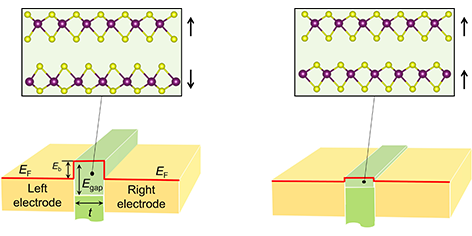
Two-dimensional (2D) Van der Waals quantum materials and heterostructures have opened unprecedented opportunities to explore new physics and device concepts. Using the theoretical modeling based on density functional theory (DFT), we explore fascinating properties emerging in 2D quantum materials, such as ferroelectricity, quantum anomalous Hall effect, charge density wave, and superconductivity, and design the promising devices for nanoscale electronics.
Research highlights:
- Tunneling valley Hall effect
- Tunneling valley Hall effect driven by tilted Dirac fermions, Phys. Rev. Lett., 131, 246301 (2023).
- 2D Antiferroelectric tunnel junction
- Two-dimensional antiferroelectric tunnel junction, Phys. Rev. Lett., 126, 057601 (2021).
- A native ferroelectric semimetal
- A room-temperature ferroelectric semimetal, Sci. Adv., 5, eaax5080 (2019).
- Spintronic properties controlled by 2D ferroelectricity
-
Switchable Anomalous Hall Effects in Polar-Stacked 2D Antiferromagnet MnBi2Te4, Nano Lett. 23, 3781 (2023).
-
Ferroelectric Control of Magnetic Skyrmions in Two-Dimensional van der Waals Heterostructures, Nano Lett., 22, 3349 (2022).
-
Interfacial Crystal Hall Effect Reversible by Ferroelectric Polarization, Phys. Rev. Applied, 15, 024057 (2021).
-
- Charge density wave and superconductivity
- Manipulating charge density waves in 1T−TaS2 by charge-carrier doping: A first-principles investigation, Phys. Rev. B, 94, 125126 (2016).
- Nature of charge density waves and superconductivity in1T-TaSe2-xTex, Phys. Rev. B, 94, 045131 (2016).
- Enhanced superconductivity by strain and carrier-doping in borophene: A first principles prediction, Appl. Phys. Lett., 109, 122604 (2016).
- Electron-doped phosphorene: A potential monolayer superconductor, EPL, 108, 67004 (2014).